
Dear friends,
Merry Christmas from… Wyoming! It’s still hard to believe I ended up in the middle of this unnaturally-rectangular territory that boasts the lowest population of any state. It has the same number of inhabitants as Baltimore, but they’re spread across an area 1,000 times larger than the city I once called home. Compared to Harlem, where I lived last year, Wyoming’s population density is 20,000 times lower! The vastness of this place is palpable. Fortunately, I have no nostalgia for the noisy, congested streets of NYC. The mountain air is thin here, but I feel like I can breathe again.
As many of you know, my time in Harlem was spent as a member of a religious order—the Franciscan Friars of the Renewal (the CFR’s). My year with them was a tremendous gift, and I still hold it to have been a necessary step in my discernment. The brotherhood was wonderful, the formation I received was solid, and I relished the ample time I could spend in silent prayer. It was a beautiful environment, kind of like a greenhouse for the soul.

My class of CFR postulants (first-year members) and some of our formators.
Nonetheless, I found myself restless. Over the past decade, the consistent pattern of my life has involved venturing with Christ into the unknown, to the parched lands and souls most in need of His mercy. Trying to conform to a well-established religious order felt like a step away from that. Their ways of doing things had solidified. I tend to thrive when I’m drawn into the wilderness, when I’m given freedom to explore, and when I am given a chance to rely upon God’s Providence. The stability of life as a CFR, while wonderful in many ways, felt somehow domesticated. In addition, I longed to draw closer to those on the fringes of society. The CFR’s have a couple houses that are well-integrated with impoverished communities, but there was no guarantee that I’d be permitted to pursue the proximity to the poor I desired.
I do not doubt that I needed to experience the nurturance that could be offered by this more-structured community. God was calling me to take a step back, to be formed myself. I was willing to continue along the path laid out before me by my superiors. My hope was that, once I completed the formative years as a CFR, I would once again be given permission to forge into the unknown. I laid all of this—my hopes, struggles, joys, and reservations—before my superiors as they weighed whether I should go on to the next stage of formation. Their answer to me was clear: “We think we need to set you free.”
I’ve spent the past few months trying to discover what this newfound freedom is for. There have been many ups and downs and days where I’ve doubted the decision of my superiors, but I trust that God’s Will is being made manifest in my present reality—not in some imagined future. Moreover, an event that took place three days after I left the CFR’s instilled a strong sense that I am where I need to be.
On this day, I had returned to the Baltimore Basilica to help out at a lunch for the homeless, just like old times. It was a bright, sunny day and I saw a number of old friends from the parish. One of them informed me that Jay, one of my longest-standing friends living out on the street, was in the hospital. His condition, and the cause of his hospitalization, was unclear. I resolved to go visit him right away, and I convinced my friend, a former missionary, to come along with me.
Jay was one of my earliest friends on the streets of Baltimore. He had panhandled at the corner of MLK and Pratt for years, and was well-known in the neighborhood. When the missionaries came to the brick patio at his intersection to set up a weekly meal for the homeless, he’d almost always be around.
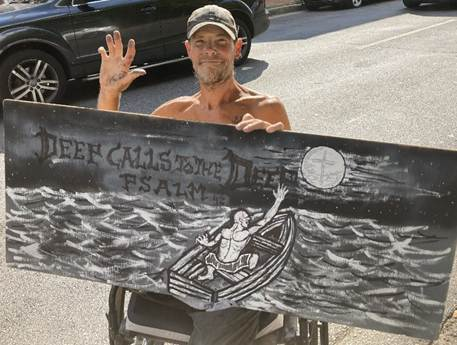
He was an emotional man, and his temperament would vacillate from extreme gratitude (which he would freely express in a way I could only describe as fatherly), to an agonizing despair (also freely expressed, in groans and tantrums), to a brooding, cantankerous silence. We learned how to reverence his reality by giving him space when he needed it and pressing in when he was receptive. He was also a gifted artist. He painted an image and verse from my favorite Psalm on a shelf for my van—all for the low cost of a chocolate milkshake. He also gave the missionaries an impressively-lifelike sketch of himself and one of his best friends that now hangs in my office at work.

Jay posing with the shelf he painted for my van. He brought to life this image of a castaway that has captured my imagination along with my favorite scripture verse: “Deep calls to deep.”
Jay and I had been through so much together that I couldn’t begin to recount it in this letter. I hope to share more of his story one day. I saw him at his best and his worst, and he supported and encouraged me in the midst of all the ups-and-downs of my time in Baltimore. I met his children and their mother when they visited him for Christmas; I drove him 14 hours to South Carolina when he decided he was leaving the streets and the drugs to return to his family; I met him at the gas station at 6am in the pouring rain when he returned, defeated and dejected; I watched infections from shooting heroin reduce his legs to rotting flesh that eventually led to a double amputation; I sought his counsel regarding dynamics on the street and unrest among the missionaries; I smiled when he led us in prayers before meals that were simultaneously heartfelt and borderline-irreverent; I attended his mother’s funeral with him; I visited him in the hospital after he was dragged out of his tent by a group of robbers who cracked his skull open in the middle of the street, and my pastor anointed his unresponsive body. The mean streets of Baltimore waged a war of attrition against his mind and body, but he always bounced back.
When my friend and I entered the hospital room, Jay was unconscious, tethered by wires to beeping and blinking diagnostic monitors and a breathing tube connecting him to a ventilator. I hadn’t seen him for a year. He looked older, particularly in the weathered-lines on his face and the patchy beard that was now washed with grey, but otherwise he didn’t look particularly unhealthy. I had seen him look far worse. I tracked down the nurse, who informed us that he had a heart attack that left him without oxygen for a significant amount of time, and it was unclear if his brain would ever recover. If I wanted more information, he encouraged me to reach out to Jay’s point-of-care, his sister in Maryland.
After the nurse left, my friend and I knelt by Jay’s bedside and began to pray. We offered up spontaneous prayers, interceding before the Lord on his behalf and begging for the graces of healing and mercy. At one point, Jay dug the backs of his elbows into the angled bed to arch and stretch his back before dropping back down again. His eyes never opened.
I texted his sister that evening to offer to help out Jay or the family any way I could. She texted me back almost immediately: “He passed a short time ago.” I was shocked. I knew his prognosis wasn’t rosy, but I had no sense that he was on verge of death when I was with him earlier that day. He had weathered so many dire storms that I hadn’t expected him to drop off so abruptly. I had always silently hoped that he would one day make it off the streets and reunite with his family. I was aware that it required a miracle to break him free from the addiction and shame that shackled him to his little intersection in Baltimore, but I’ve seen it happen before. I always knew he had it in him. His time just ran out.
Losing a friend is never easy. I was particularly sorrowful when I thought about his children, who will have to live with the reality of knowing their father never found the motivation to return. Nevertheless, the predominant feeling that welled up in my heart was a sense of awe. I was astounded by the sheer magnitude of providence that enabled me to leave the CFR’s in Harlem just in time to see my friend one last time and to intercede for him at his deathbed. Despite the loose ends that remained at the end of Jay’s life, I felt as though this entire situation had been intricately orchestrated. There was nothing accidental, nothing coincidental, about our final encounter.
I seem to have an uncanny knack for having powerful encounters with people before they die. Perhaps this is just the nature of working with men and women in life-threatening environments, but I have had a handful of deeply meaningful conversations or opportunities to pray with people right before they pass. I believe the Lord arranges these meetings for a reason. My hope is that I somehow help these men and women become more receptive to the Lord’s mercy as they near their final hour. If nothing else, these encounters have engendered a strong sense that God never stops pursuing a soul—that He goes out of His way to seek the lost sheep. I am not sure why I’ve been blessed with these timely encounters, but I resonate with the experience of the protagonist in Bernanos’ novel Diary of a Country Priest. Reflecting on a powerful conversation he had with a woman just before her unexpected death, the parish priest writes: “Our Lord needed a witness, and I was chosen for want of anyone better, as one might hail a passerby.”

Jay’s sketch of himself with his best friend on the streets.
I also believe that the gift of my final encounter with Jay was somehow for me. It felt like closure. While I don’t believe that perfect closure is ever attainable when you deeply love someone or something, Jay’s death signified the conclusion of two chapters in my life. The first, my time in Baltimore, a city that I intended to live and die in and whose people I wanted to expend myself in serving. The second, my time with the CFR’s, a group that has formed me in many ways and within which I considered lifelong vows. Both of these communities glimmered with the possibility of being a final resting place, a final commitment and concluding chapter. Both ended abruptly. Their time ran out, and it was time to move on.
Since that time, my journey has stretched out westward, towards the setting sun. I spent the summer in eastern Kentucky, living in my van outside a tiny parish with a priest and his 260-pound dog. While I was there, I made friends with a couple of nuns starting a religious order and immersed myself in the homeless community in Lexington. I also spent some time in Nebraska, a fertile seedbed not only for corn, but also for some of the most solid and supportive people I’ve ever met. These were both beautiful communities, but an opportunity for work in Wyoming presented itself, and the doors kept opening up.
I’m now working as a formator at Wyoming Catholic College in the small town of Lander, an outdoorsy town at the foot of the Wind River mountains. It’s a small liberal arts college with an integrated outdoor curriculum, and my job is somewhat akin to a campus minister. I was sold on the educational vision of the college, and the students here are amazing. They give up their cell phones, engage with the greatest works of Western culture, and frequently romp about the Rocky Mountains on adventures. It’s an idyllic community in so many ways. Nonetheless, it became quickly apparent that all these goods are not enough to cover up the sources of impoverishment that fester among the student body. These students are exceedingly busy and constantly incited to perform, to compete with one another in the pursuit of excellence, but they are not taught how to pray, how to receive the gaze of the One Who loves them just as they are. They have spontaneous and invigorating debates about philosophy and theology into the wee hours of the night, but they often feel they have no space to share their heart with one another—to confide their inner reality to a friend. I think I’m here to help change that. After one semester, I can already see the culture beginning to shift.
In my interviews with the college, I was also adamant that the only way I would remain out here for more than a brief stint would be if I could somehow remain close to the poor. This is why I’ve opted to live at St. Stephen’s, an old Jesuit mission on the Wind River Reservation. The Jesuits pulled out fifteen years ago, and the Diocese of Cheyenne has inherited the daunting task of ministering to the Shoshone and Arapaho tribes, a dwindling remnant scattered across 2 million acres of reservation land.

A few dilapidated shacks less than a mile north of St. Stephen’s. To the right, you can see a sulfuric acid plant, which was once a uranium mill on land allegedly stolen from the tribe and contaminated by radioactive waste.
In many ways, the landscape is stunning—rolling golden prairies fissured by snow-fed rivers flowing from the majestic Wind River mountain range—and yet its wide expanses resound with a loneliness that echoes the grief of its displaced people. Their reality is a far cry from the free-roaming, communal ways of their ancestors: they reside in dilapidated trailer parks where nasty dogs roam day and night; or they wrangle on fence-wrapped ranches dotted by cattle heavy with beef; or they’ve tried to forge a new life off the reservation in suburban housing projects; or they hole up in wooden shacks atop wind-swept grasslands whose solitude is only pierced by the faint glow of distant casinos. As their tradition ways wilted, addiction and poverty shot up like weeds, eager to strangle the last drops of strength from a dwindling people. These pestilent crops have refused to be uprooted, and many Natives still harbor resentment against the unwelcome society that polluted not only their land, but their entire cultural landscape.
These are the kind of people I want to be close to. I’m still discerning how, if at all, this could happen. Slowly, in spite of my ignorance and missteps, bridges are being built. I hope to share more stories in a future letter. Please pray that my efforts may be guided, and perhaps even blessed by, our God—the Father and Protector of the Poor. If I continue to feel called in this direction, I will need not only supporters excited to launch and animate this mission, but also others willing to run alongside me.
Otherwise, I’ve been enjoying myself. I’ve explored the Wind River Mountains, climbed limestone cliffs, bruised my hands at the skatepark, became certified as a Wilderness First Responder, learned to ride a motorcycle, and, after years of wanting to see the Northern Lights (my first van was named ‘Aurora’), I spent the night sleeping under the gaze of red and green waves, ebbing and flowing across the wide horizons of the Wyoming wilderness.

One of the few pictures I’ve managed to take from my time in the Wind River Mountains.
I’m in a good place, but I’ve stopped trying to conjecture how long I’ll be here. I’ve learned that there’s never a guarantee that a community will last, but that doesn’t have to prevent me from living and loving intensely right now—until my time runs out.